

Anushree Srivastava, Lead Digital Advisor, Rodic Digital & Advisory
28 Sept 2026
Executive summary
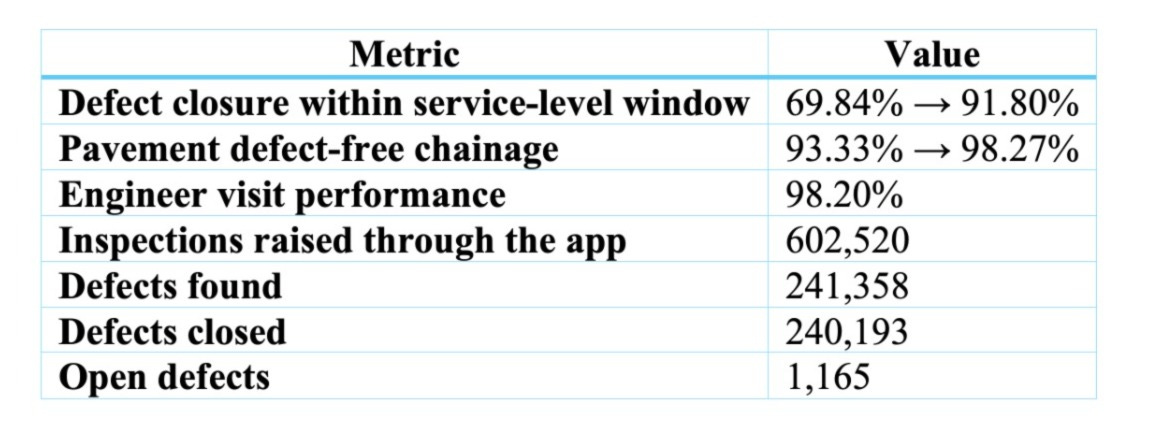
Output and Performance-based Road Maintenance (OPRMC) pays for road condition rather than road activity, and Bihar’s programme shows it works when every defect becomes evidence. Since the Integrated Command & Control Centre went live on 20 July 2022, defect closure within the service-level window rose from 69.84% to 91.80%, and pavement defect-free chainage moved from 93.33% to 98.27%.
That result rests on three stacked layers. The performance model defines the outcome as a service level. The digital layer, the RCD Road Maintenance App, gives every defect a unique ID, geo-tagged photographs and a timestamped approval trail. The intelligence layer, Rodic Nxt AI, extends observation from sampled inspection points to continuous, network-wide condition grading.
This paper describes each layer, reports the operational evidence from Bihar, and sets out how AI-based condition assessment can move road asset management from reactive repair to predictive maintenance, while keeping accountability with engineers rather than algorithms.
Keywords: performance-based maintenance, OPRMC, computer vision, GIS, human-in-the-loop AI, road asset management
1. Context: why conventional maintenance falls short
Conventional road maintenance pays for effort, not condition, so repair usually arrives on the expensive side of the deterioration curve. Road networks deteriorate continuously, but most regimes observe them only intermittently.
Defects follow a known progression. Cracks and ravelling have low impact at first. Left unattended for 45–60 days, they become heavy ravelling and potholes. After a further 30–45 days they turn into structural distress and cyclic deterioration.
The cost of arriving late is borne by the road user in safety, comfort, travel time, vehicle operating cost, fuel and emissions. For the road authority, input-based maintenance brings high O&M cost, slow rectification, selective attention and cumbersome oversight.
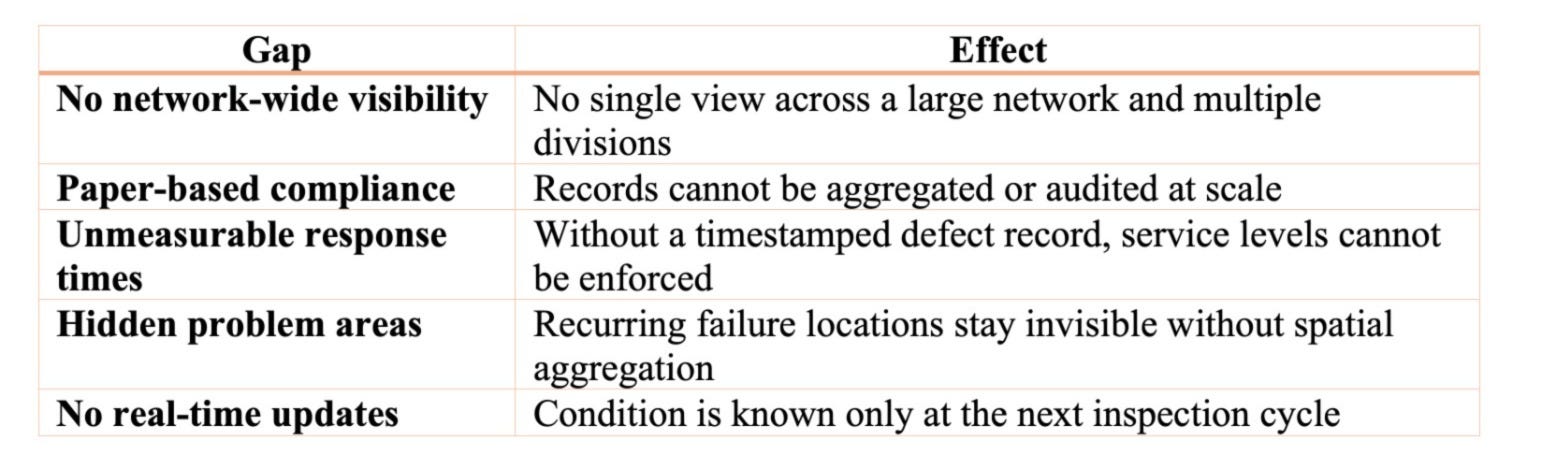
Before digitisation, even an outcome-focused regime faced five monitoring gaps:
2. What OPRMC is and how it works
OPRMC changes what the road authority buys: a defined service level on the road, maintained over time, instead of a schedule of works executed. The maintainer carries the outcome, and non-compliance with the service level has consequences.
2.1 Service levels defined defect by defect
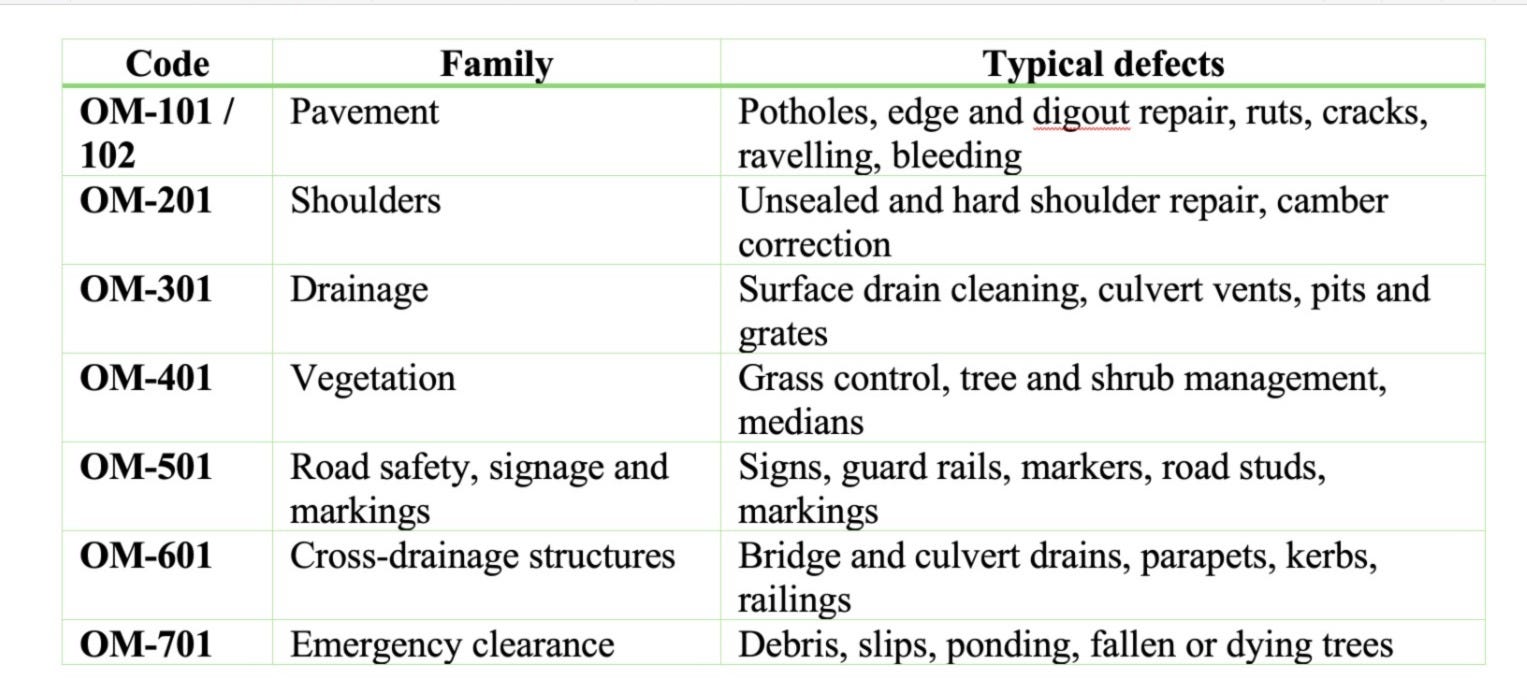
An outcome model is only auditable if the outcome is defined precisely. In Bihar, ordinary maintenance is specified through seven defect families, each with its own code. That shared vocabulary is what lets field engineers, maintainers and machines describe the same problem in the same way.
2.2 A structured inspection regime
Accountability is allocated by role and road, with minimum inspection frequencies built in. Junior Engineers make four visits per road per month and Assistant Engineers two. Executive Engineers visit their roads monthly, and Superintending Engineers cover one-third of allocated roads each month. Programme-level decision makers monitor the performance of both engineers and maintainers.
A mandatory visit that cannot be verified is a visit that may not happen. Geo-fencing and geo-tagged evidence are what close that gap.
3. From evidence to intelligence: the digital and data framework
An output model is unenforceable at scale without evidence. Bihar’s digital layer turned the service-level definition into a measurable regime, and the intelligence layer now extends that evidence from sampled points to the whole network.
3.1 The digital layer: RCD Road Maintenance App
The Integrated Control & Command Centre, inaugurated on 20 July 2022, runs on mobile and web applications that put every stakeholder in one ecosystem. The mobile app serves field engineers and maintainers: mandatory visits, raising and approving defects, geo-fencing and geo-tagged photographs at source. The web app serves headquarters: compliance checks, dashboards, defect maps, inspection reports and performance analytics.
Every defect travels the same four-stage path, and each stage leaves a timestamped photographic record.
A rejection sends the defect back to the maintainer under its original ID, so closure is never taken on assertion. On the network map, six states are shown: open (crust), open (other than crust), closed pending verification, rejected or re-opened, closed and verified, and no defect.
3.2 The intelligence layer: Rodic Eye
Rodic Eye is an AI-driven Project Management Unit (PMU) layer that connects road data capture to an actionable maintenance record. It runs in three stages, capture, assess and act, and feeds the same workflow already used for OPRMC monitoring rather than a parallel system.
An initial 2,000 km deployment yields roughly 20,000 graded 100 m segments per survey cycle, each tied to its chainage and coordinates.
3.3 Condition assessment method
The core shift is from recording defect events to measuring condition, so the network becomes comparable segment by segment and over time.
Rodic Nxt AI Index (REI): a 1–5 grade from good to poor, with a severity level assigned to every detection rather than a simple present-or-absent flag.
One vocabulary: every detection is coded to the same OM family and sub-type used in manual inspection (for example OM_102_A, OM_601_B).
Full metadata: road name, chainage from and to, latitude and longitude to six decimals, bearing, date, time, the annotated image and the raw source frame.
That metadata is what lets a detection be verified, mapped, compared across surveys and, if accepted, acted on. An index that specifications can be written against is worth more than a dashboard.
3.4 Human-in-the-loop governance
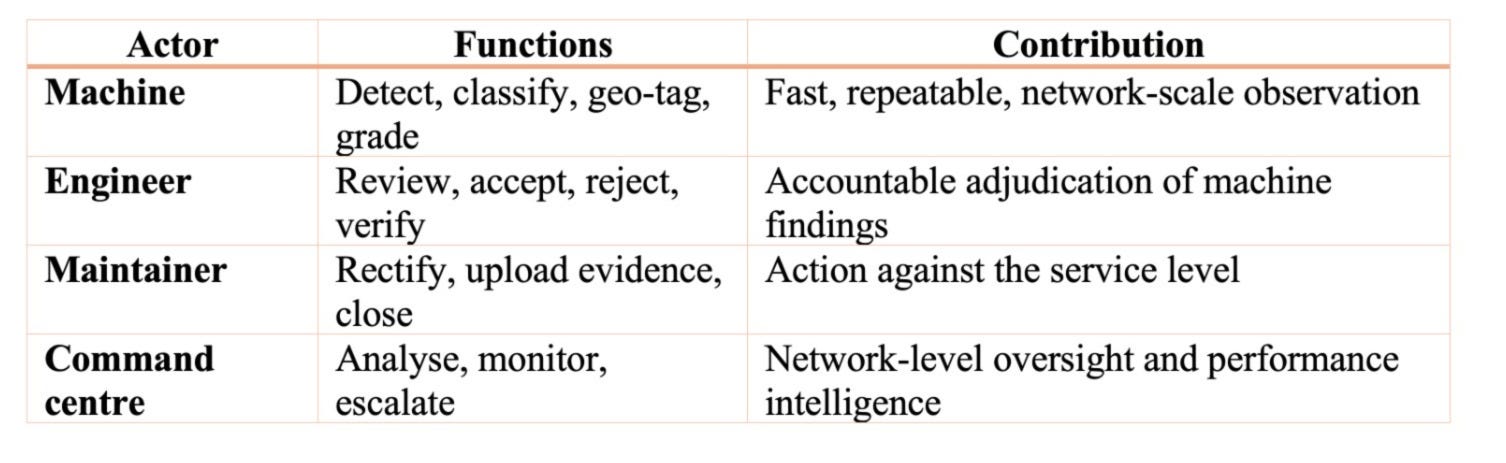
AI accelerates detection; people stay accountable for acceptance, verification and action. The system is an evidence chain that makes engineering decisions faster and more defensible, not autonomous decision-making.
4. Implementation approach
Scaling AI-enabled monitoring works best in three phases: platform set-up, a baseline survey, then continuous monitoring. Core OPRMC functionality continues unchanged throughout, because the AI capability is an additive layer, not a replacement.

Phase B matters most for what follows. Change detection needs a reference point: without a high-quality baseline, later surveys can record condition but cannot reliably measure deterioration.
5. Benefits and outcomes
Bihar’s results are recorded, not asserted: the digital layer has closed 99.5% of the defects it has recorded since go-live on 20 July 2022. Figures below are cumulative, taken from the OPRMC programme dashboards.
The programme reports three benefits: transparency through geo-tagged, evidence-based inspection; accuracy through unique defect IDs and timestamped closure evidence; and faster decisions through dashboards, map views and analytics. The Command Centre has hosted NHAI leadership, Asian Development Bank delegations and road agencies from Odisha and Chhattisgarh.
5.1 What AI adds
Network-wide visibility: every surveyed 100 m segment is assessed, not only sampled inspection points.
Earlier detection: deterioration surfaces between routine inspection cycles.
Prioritised action: severity, condition grade and spatial patterns focus engineering attention.
5.2 The road asset intelligence loop
The lasting value lies in a compounding cycle, where each stage produces the input for the next.
[embed: node/65563adf-5cfd]
Every inspection is a potential training label. The durable asset is the verified history of what was detected, what was fixed and how it held up; imagery can be recaptured, but that history cannot.
6. Challenges and recommendations
The architecture and operating model are proven; model performance in the field still needs to be measured and published. Five questions should guide field validation.
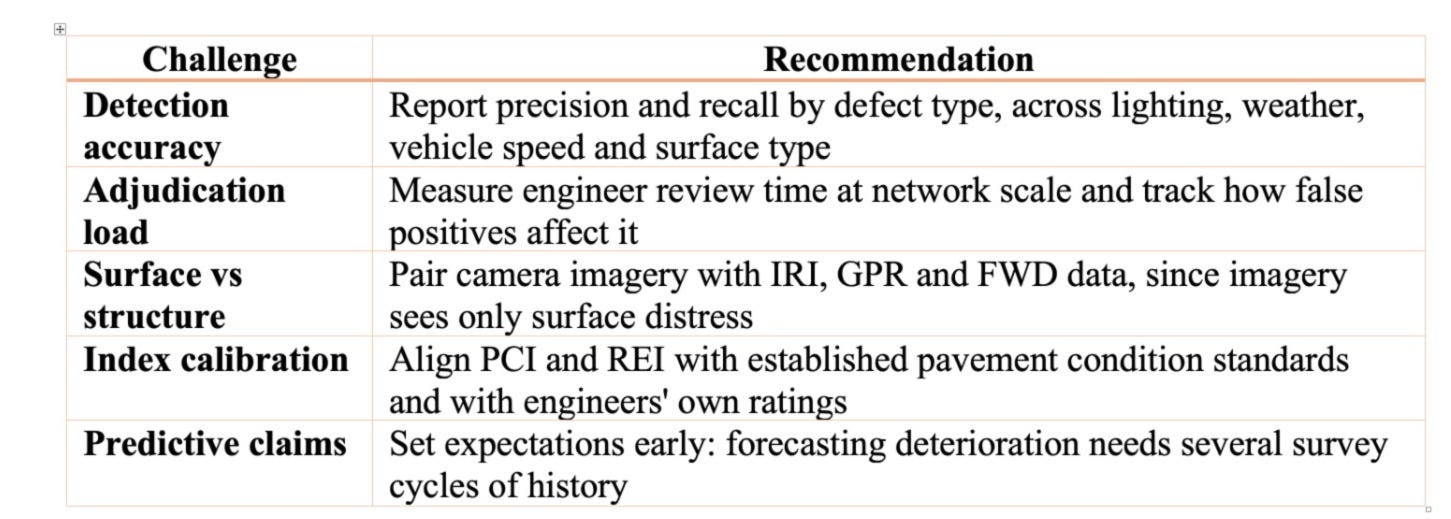
For road authorities considering OPRMC, three lessons carry over from Bihar. Define service levels code by code so they can be audited. Make every defect a geo-tagged, timestamped record before adding AI. Then keep a named engineer accountable for every machine finding that becomes a defect.
7. Conclusion
OPRMC made road condition a matter of evidence; Rodic Nxt AI aims to make that evidence intelligent. By linking capture, condition assessment, GIS, the defect workflow and engineering governance into one loop, the approach extends performance-based maintenance from sampled inspection to continuous, network-wide monitoring.
The design keeps accountability where it belongs: machines observe at scale, engineers decide, maintainers act and the command centre oversees. With a sound baseline and repeated survey cycles, the growing record of verified outcomes offers a practical path from reactive repair to predictive road asset management.
About the author
Anushree Srivastava is Lead Digital Advisor at Rodic Digital & Advisory, where she works on digital and AI-enabled monitoring for road asset management.
Source
Adapted from Rodic Digital & Advisory material prepared for the Government, Road Departments, Operational figures are from the OPRMC programme dashboards.